By understanding why some water and retardant drops from
firefighting aircraft work well and others don’t, CFA can offer
practical guidance to improve the effectiveness of these aircraft.
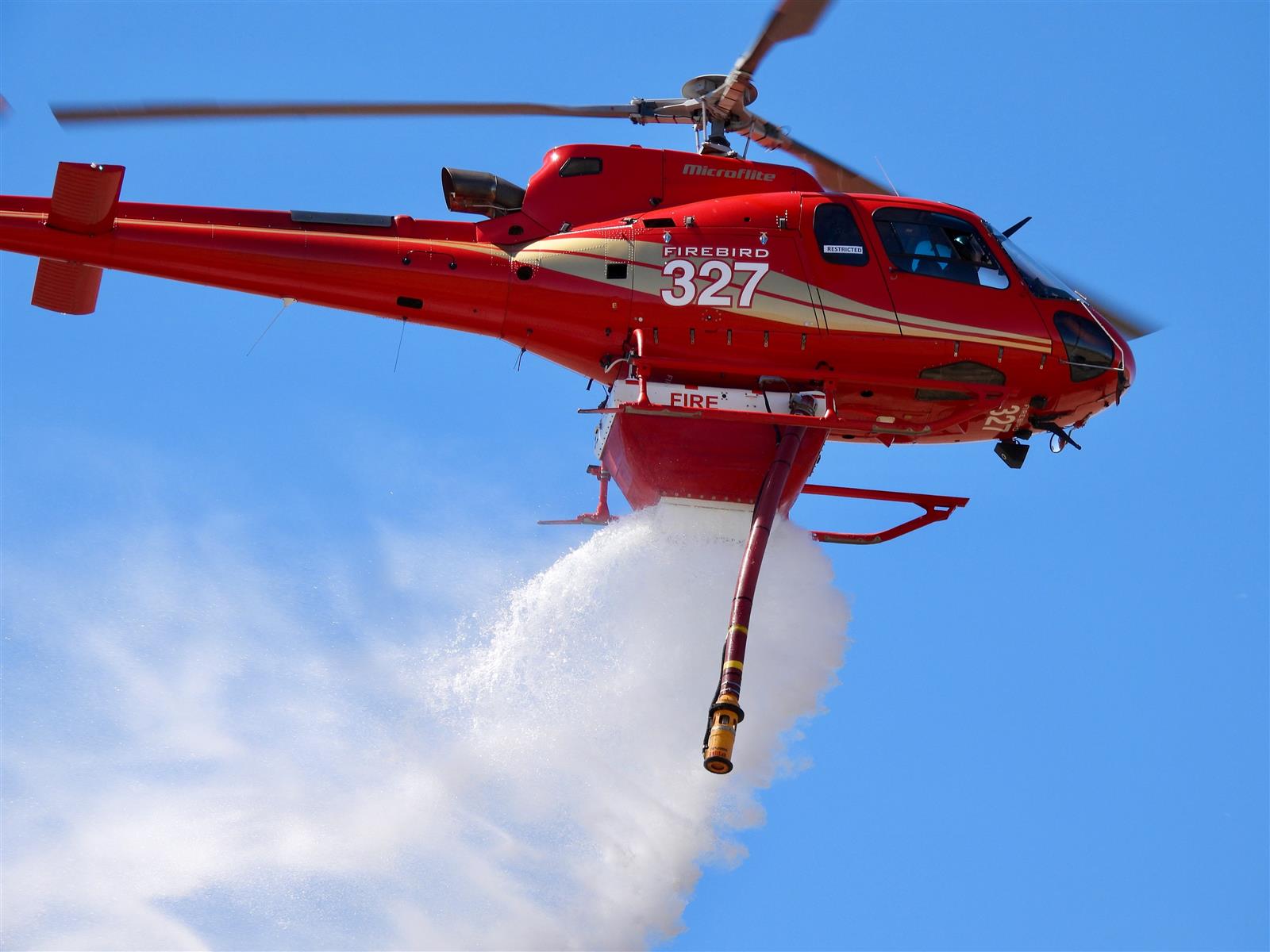
During the 2023-2024 and 2024-2025 fire seasons, 51 water and retardant drop tests from eight firebombing aircraft were conducted at Balliang and Mount Mercer.
This research was supported by contractors, landowners, CFA staff and volunteers, and partner agencies including the Department of Energy, Environment and Climate Action (DEECA), Fire Rescue Victoria, Emergency Management Victoria and Parks Victoria.
By examining how aircraft speed, drop height, and tank or door controls influence coverage, continuity and penetration, we can better understand what each aircraft does well and where its limitations lie. As we bring in newer and larger aircraft with different tank systems, we want to be sure they're delivering the performance we need.
Drop testing also helps build a clearer, shared understanding of the aircraft fleet – aircraft with similar capacities can produce different drop patterns.
Drop testing helps us understand how flight parameters and tank settings influence drop quality, shows how different tank designs behave in practice, and allows us to begin using evidence to match aircraft to the tasks they are best suited to.
During the testing, each aircraft was flown through a series of drops over a purpose-built test grid in grassland and wooded vegetation to allow the drop characteristics to be measured consistently. Each grid comprised between 700 and 1,200 sampling cups arranged in a rectangular pattern at three-metre spacing. At each grid point, sample cups were placed to collect the water or retardant from each drop.
Baseline testing was undertaken under calm conditions, with aircraft flown at prescribed speeds and heights. After each set of drops, the sample cups were collected and weighed, and the distribution and density per area of suppressant was calculated.
Testing showed how the delivery system influenced whether a drop is dense and continuous or thin and broken up. Feedback from air attack supervisors reinforced that an effective drop is defined less by total volume and more by penetration into the fuel bed, consistent density and continuity. Overall tank design and pilot experience were consistently identified as the strongest determinants of drop quality.
A key part of this work was measuring how much volume of suppressant an aircraft can lift. Testing showed that the volume an aircraft reports is not always the volume that ends up being dropped. How much can be lifted is influenced by tank design limitations as well as aircraft weight and balance tolerances, which means the delivered load can vary between each drop.
We are continuing to progress this line of work with further consultation with aircraft contractors in partnership with DEECA and CFA aviation teams.